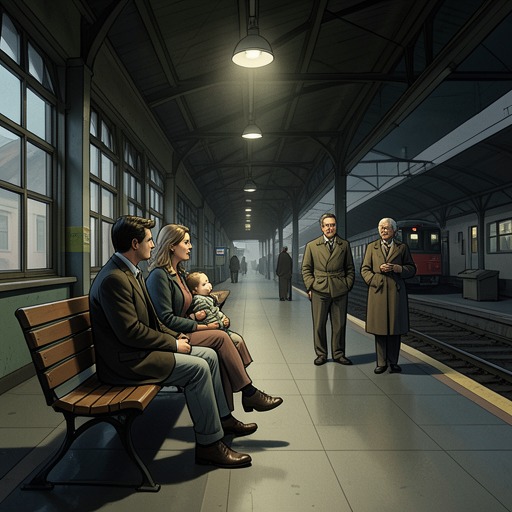
Driss
And Their Children After ThemDriss is Hacine’s cousin in Morocco, a friend and business partner whose introductions and practical help shape Hacine’s life during his forced stay there. He brings Hacine into a familiar-seeming circle of young men, helps him enter the cannabis trade, and later joins him in attempting to turn their profits into legitimate property investments. That venture collapses into fraud, debt, and violence: Driss is seized near the Beaux-Arts and has an eye gouged out with a screwdriver, an assault that helps bring their enterprise to an end.
Identity and Introduction
When Hacine first arrives in Tétouan, he expects to find only people he regards as backward and alien. Driss introduces him to his own friends, including Rashid and Medhi, and Hacine discovers that their everyday interests are much like his: spending time together, smoking, playing video games, laughing, and thinking about girls. The introduction shifts Hacine’s experience of Morocco from isolation and contempt toward companionship. Driss is not merely a relative waiting at home; he is the connection through which Hacine finds a social world in which he can feel at ease.
The group’s shared leisure has a distinctive local setting. They smoke hash, eat pastries sticky with sugar and honey, and drink mint tea, lingering in the heat. During one session, Abdel brings over The Guinness Book of Records, and the boys laugh over its pictures of people at the extremes of human size. These episodes establish the ease and intimacy of the group before the story turns to money and danger. Driss’s place in them is that of Hacine’s cousin and guide into a circle whose pastimes feel recognizable even as the surrounding country is new to him.
From Cousins to Business Partners
Driss also gives Hacine his first opening into dealing. He slips him a few dozen grams of cannabis resin, allowing him to begin selling to tourists at a low level, practically in the street. Hacine uses the proceeds to buy a kilo and then invests in shipments bound for France and Germany. The narrative presents this expansion as a shared commercial world, although it identifies Driss’s concrete initial contribution as providing the first small supply. Hacine’s dealings soon generate tens of thousands of francs each month by the time he is twenty.
As the business grows, the cousins confront a problem created by their success: money is accumulating faster than they can spend it or channel it through friendly businesses. Cash and bank accounts sit idle, and both men resent the limits on their ambition. They discuss the surplus and seek legal investments, preferably in real estate. Driss therefore appears not only at the beginning of Hacine’s trade but also at the point where the cousins try to convert illicit earnings into a more durable and respectable form of wealth.
The Property Scheme and Its Consequences
A contact proposes presold villas for Europeans planning to retire in Moroccan towns including Saida, Essaouira, Nador, Tétouan, and Tangier. The promised return is three dirhams for each one invested. Driss and Hacine research the offer, visit the sites, and see neat white villas and bankers and architects in fine suits. The contact’s record appears impeccable, and he accepts foreign currency and cash. Reassured by these signs, the cousins decide to invest.
The apparent legitimacy proves worthless: after taking their money, the man disappears. Driss and Hacine are stunned and initially cannot speak about the humiliation. Then letters arrive from the places where they invested. The projects have been started, and workers, bureaucrats, and others demand payment. Crucially, the cousins’ signatures appear on the legal documents authorizing the work, so the losses are not confined to the money already stolen; they are being pressed for enormous additional sums.
At first, the cousins ignore the demands. Further letters, now handwritten and abusive, are followed by threats. The danger becomes physical around Hacine’s family home, where a fire breaks out in the stairwell and the two men begin to feel watched. Driss is then grabbed near the Beaux-Arts by three men: two hold him while the third gouges out one of his eyes with a screwdriver. After this attack, they pay. The sequence turns the failed investment from a financial embarrassment into a direct bodily threat, and marks the point at which their attempt to expand can no longer continue on its previous terms.
Role in Hacine’s Departure
The attack on Driss is one of the immediate circumstances surrounding Hacine’s decision that the enterprise is over. At the same time, Hacine’s father is experiencing heart problems, and Hacine decides to go home. He returns to Heillange carrying fear, shame, and the last of his savings. Driss’s subsequent whereabouts and condition are not given in these scenes, so his story does not receive a separate resolution.
Driss’s significance lies in the two kinds of passage he enables for Hacine. Through him, Morocco first becomes a place of friendship and shared pleasures rather than simply a destination imposed by Hacine’s father; through the small supply he provides, it becomes the site of Hacine’s rapid rise as a dealer. The later property scheme exposes the limits of that rise. The cousins try to move their money into conventional investment, but the legal paperwork leaves them responsible for unfinished projects while the supposed developer vanishes. Driss’s injury makes the cost of that failure unmistakable, and Hacine’s return marks the abrupt end of the future they had tried to build together.